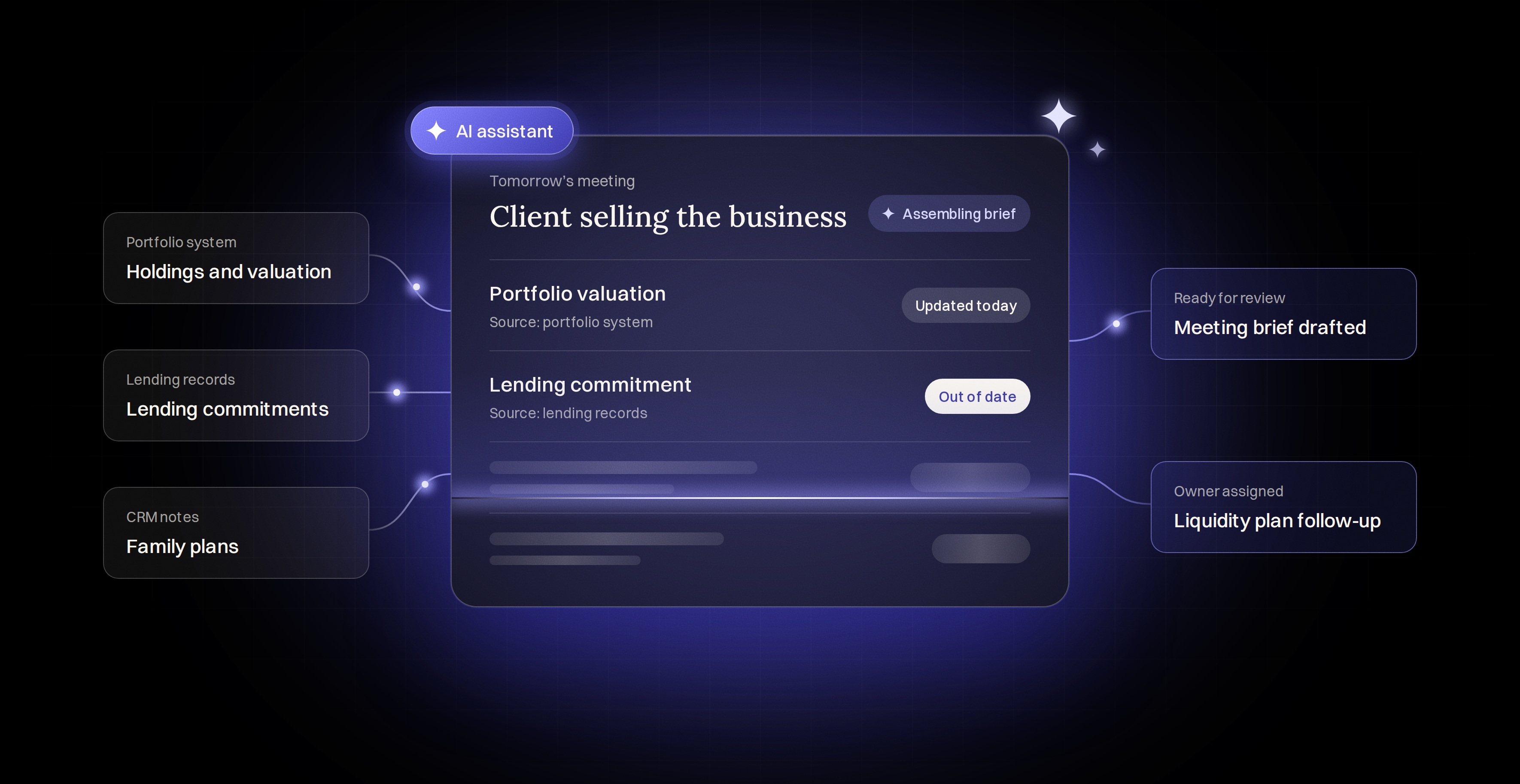


A client is selling a business. Before tomorrow’s meeting, their private banker needs to bring together portfolio holdings, lending commitments, and the family’s plans. An AI assistant could shorten that preparation considerably. What the bank does with the time it saves will determine whether the client benefits.
AI in private banking can make research easier to access, reduce administrative work, and support more relevant client conversations. It also forces a commercial choice: use the extra capacity to serve more clients, give existing clients more attention, or reduce the cost of service. Buying the technology does not settle that choice.
AI Is Becoming Part of the Working Day
In June 2024, Morgan Stanley reported that 98% of its Financial Advisor teams had adopted its AI research Assistant. It also launched Debrief, which, with client consent, generates meeting notes and drafts follow-up emails for advisors to review and send.
These are practical applications with a clear place in an advisor’s routine. Finding relevant research and documenting conversations take time. Helping with those tasks gives bankers a credible reason to use AI beyond an initial demonstration.
But adoption is an early measure. A bank still needs to establish whether preparation is more accurate, follow-up is faster, and the time saved survives the effort required to check the output.
Banks Need to Decide Where the Saved Time Goes
A head of private banking and a finance director may look at the same productivity gain and see different opportunities. One sees room for more frequent client conversations. The other sees scope to increase the number of relationships each banker manages.
Both can be reasonable choices. They produce different businesses.
BCG’s 2026 wealth research explores how AI could alter advisory economics, including advisor capacity and the balance between human and automated services. The outcomes remain scenarios, but the choices they raise are already relevant to bank leaders.
A bank promising a highly personal service needs to consider how a larger client book affects availability. Time saved on meeting preparation may disappear into a fuller calendar. Alternatively, retaining the same client load could create room to involve specialists earlier or address matters that previously waited for an annual review.
The service model, staffing assumptions, and measures of success should reflect the choice. Otherwise, a bank may promise deeper relationships while rewarding bankers mainly for managing more of them.
A Wealth Band Cannot Explain a Client’s Next Decision
Capgemini’s World Wealth Report 2026 reports that 97% of wealth management firms still segment clients primarily by wealth bands. Its global research highlights how strongly service models remain tied to the amount of wealth a client holds.
That is a useful starting point for allocating resources. It is a limited guide to what a banker should discuss next.
Two clients with similar portfolios may need very different attention. One is approaching retirement. The other is preparing to sell a company, repay borrowing, and support adult children. Their investment balances can look alike while their priorities have little in common.
AI could help bring relevant details from authorized records to the banker’s attention: a planned sale mentioned in a previous meeting, a loan approaching maturity, or a question that still needs a response. The banker then needs to confirm the circumstances and decide what warrants a conversation.
This gives personalization a practical meaning. A client should receive attention when something important changes, with advice informed by the wider situation. Adding their name to a market update offers much less value.
The Quality of the Briefing Depends on the Records Behind It
Consider the business-sale meeting again. The assistant retrieves the latest portfolio valuation, but the lending figure is out of date. A note about gifting money to the client’s children records an idea discussed last year, not an agreed plan.
A fluent summary can make those differences harder to notice. The banker needs to see where the information came from and when it was updated, especially when it will shape a recommendation.
Deloitte’s 2026 interviews with wealth management leaders across Europe, North America, and Asia-Pacific identify data readiness and operating model complexity among the barriers to technology execution. The research also notes that much investment remains focused on core platforms and data foundations.
For banks, the work can span portfolio systems, lending records, CRM notes, and documents held by different teams. They need to establish which records take precedence, how conflicting information is resolved, and what each user is permitted to access.
The same discipline applies after the meeting. If the client asks for a revised liquidity plan, the request needs an owner and a route to completion. An AI-generated task that sits unassigned in another application has added to the workload without advancing the client’s request.
Giving AI Permission to Act Changes the Responsibility
An assistant that drafts a meeting summary and an agent that updates a client record perform different roles. An agent that initiates a transaction carries a different consequence again. Each requires a deliberate decision about authority and review.
ESMA’s May 2024 statement on AI in retail investment services makes clear that management remains responsible for decisions, including those taken using AI-based tools. The statement also covers credit institutions providing investment services.
For a bank, that means defining which actions are permitted, which require approval, and how a reviewer can trace the supporting information. The person approving an action must have a realistic opportunity to identify a problem and stop it.
Review is work, and its cost belongs in the business case. So do corrections, monitoring, and the handling of exceptions. A tool that produces a draft quickly may still leave a specialist with a lengthy checking task.
Judge the Investment by the Service It Delivers
Private banks should assess AI against the service they want to run. That requires following work through to completion, rather than stopping at the moment an output appears.
For meeting preparation, measure the time needed to produce a brief the banker can rely on, including corrections. For follow-up, track how quickly agreed actions are completed and how often teams have to enter the same information again. For the wider business case, assess cost per relationship alongside responsiveness and the quality of client interactions.
Those measures help distinguish a useful productivity gain from work that has simply moved to someone else.
We believe the most valuable use of AI in private banking will be to help institutions deliver on the service they promise. That takes reliable information, clear responsibilities, and a decision about how additional capacity should benefit the business and its clients.
For the client selling a business, the result is easy to recognize. The banker understands the situation, brings the right expertise into the conversation, and follows through on what was agreed. The bank’s AI investment should be judged by how consistently it makes that happen.
Related reading: Our approach to AI agents in financial services