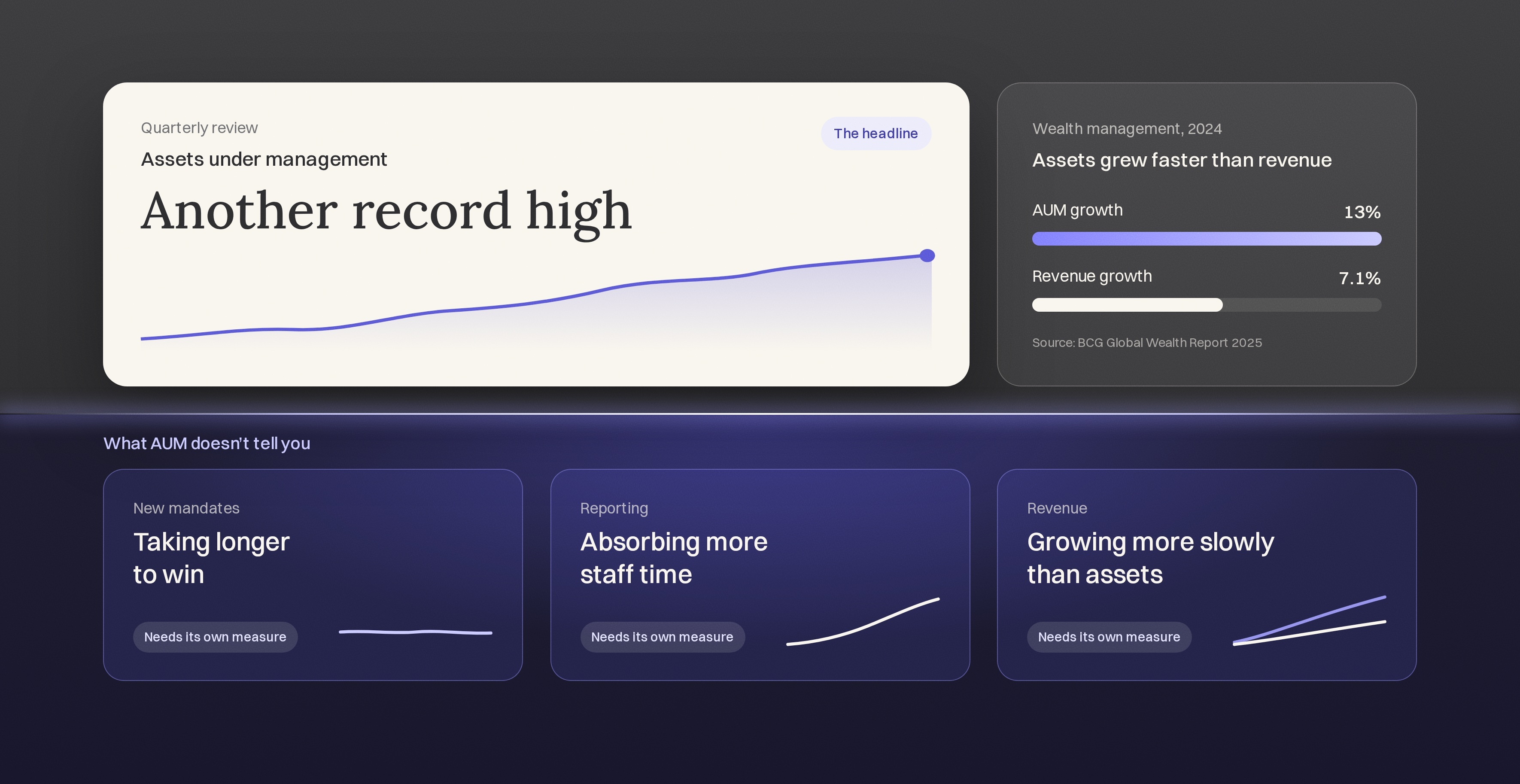


At the quarterly review, assets under management have reached another high. The investment team has delivered good returns. The headline looks reassuring. Elsewhere in the business, new mandates are taking longer to win, reporting is absorbing more staff time, and revenue is growing more slowly than assets.
All of those things can be true at once. Rising AUM measures the size of the asset base. It does not tell a wealth or asset manager whether its client franchise, pricing, or operating capacity is improving. For a smaller firm, relying too heavily on that headline can delay decisions until a less favorable market makes them harder.
Market Gains Can Make a Firm Look Healthier
BCG’s Global Wealth Report 2025 found that wealth management AUM increased by 13% in 2024, while revenue rose by 7.1%. This illustrates why growth in assets and growth in the business deserve separate examination.
The pattern is also relevant to asset managers. BCG’s Global Asset Management Report 2026 estimates that market appreciation accounted for more than 80% of gross revenue growth in 2025. That finding highlights how much reported expansion can depend on forces outside a firm’s commercial activity.
Investment performance matters to clients and can support future business. The problem begins when its effect on AUM is treated as evidence that acquisition, retention, and operations are all working well. Those parts of the firm need their own measures.
Separate New Business From Rising Asset Prices
A useful growth review starts by explaining how opening AUM became closing AUM. Identify client inflows and outflows, investment performance, currency effects where relevant, and assets added or removed through acquisitions or disposals. Keep the categories consistent and avoid counting the same movement twice.
This makes it possible to distinguish new client money from increases in the value of existing portfolios. It also separates business won by the firm from assets acquired with another company. Each can contribute to growth, but each asks something different of management.
Net flows then need a closer look. A positive total might depend on one large client adding money while several smaller relationships leave. A negative total might reflect a planned withdrawal rather than dissatisfaction. Aggregate flows tell you where to investigate; they do not explain the cause.
For a wealth manager, examine new mandates, additional assets from existing clients, and the reasons for withdrawals. For an asset manager, look at flows by fund or strategy and the distribution channels that produced them. Changes between products inside the same firm should not be mistaken for external growth.
Revenue Growth Needs Its Own Explanation
Two firms with the same AUM can earn very different revenue. The difference may reflect fee schedules, client mix, product mix, discounts, or the proportion of assets on which fees are charged.
Track recurring management or advisory revenue against average fee-bearing assets over the same period. That provides a useful view of realized revenue yield. Keep performance fees and exceptional income separate so they do not disguise a change in the recurring business.
A falling yield is not automatically a bad decision. A lower-priced mandate might be straightforward to service and strategically valuable. It becomes a problem when the firm has neither understood the reduction nor adjusted its assumptions about the work required.
The important question is what remains after delivery costs. A firm can add assets and revenue while making less profit if servicing demands grow faster. Owners need to understand which relationships or strategies contribute sustainably and which depend on effort the headline does not reveal.
Look at the Work Behind Each Relationship
For a smaller team, a handful of demanding relationships can change the operating picture. Bespoke reports, repeated data checks, complex billing, and coordination across providers may absorb the capacity expected to support new business.
Some of that effort is justified by the service clients are paying for. Some comes from avoidable rework. Treating both as the same overhead makes it harder to see where the firm should invest or change its approach.
Deloitte’s 2026 wealth technology research identifies the importance of improving complete client journeys and the handoffs between teams. That perspective is useful here: an efficient step does not guarantee an efficient service if the work has to be checked, copied, or repeated elsewhere.
Start with a few activities that regularly consume capacity. Measure how long a reporting cycle takes, how many exceptions remain unresolved, or how much correction is needed before invoices can be issued. Follow the task through to completion rather than measuring only the time a system takes to produce an output.
Include the work done by founders and senior staff. Time spent resolving routine issues may not appear as a new expense, but it reduces the time available for investment decisions, client relationships, and business development.
Test the Business Without a Helpful Market
A growing asset base can make additional hiring or fixed expenditure feel comfortable. Before committing, examine how the recurring business would behave if market values stopped rising or fell.
The exercise does not require a prediction. Use a few explicit assumptions about asset values, net flows, fees, and delivery costs. Consider which revenues adjust with AUM, which expenses remain fixed, and how quickly the firm could respond.
For firms with performance fees, keep that income distinct from the revenue needed to cover ongoing commitments. If a strong year has funded a larger permanent cost base, the next year may need more than good intentions to sustain it.
The aim is to identify decisions while the firm still has choices. A recruitment plan may remain sensible. A new service may be worth developing. The business case should explain how either is supported by repeatable revenue and available capacity, not simply by a recent portfolio valuation.
Build a Better Growth Conversation
AUM belongs in management reporting. It needs company. Pair it with net flows, recurring revenue yield, operating profitability, and a small set of measures showing whether the team can deliver the promised service.
Then discuss the reasons behind changes. A pricing concession, an investment in a new market, or a deliberate period of heavier onboarding may be worthwhile. What matters is that management can distinguish an intentional tradeoff from a deterioration nobody has addressed.
A sound growth story explains where assets came from, what they earn, and what it takes to serve them. That is a more demanding conversation than celebrating the latest AUM record, but it gives owners a better basis for building the next stage of the firm.
At the next quarterly review, the record asset base can still be good news. The stronger result is knowing that the firm has earned new relationships, retained its pricing discipline, and created the capacity to support what comes next.
More industry perspectives: Performativ Pulse