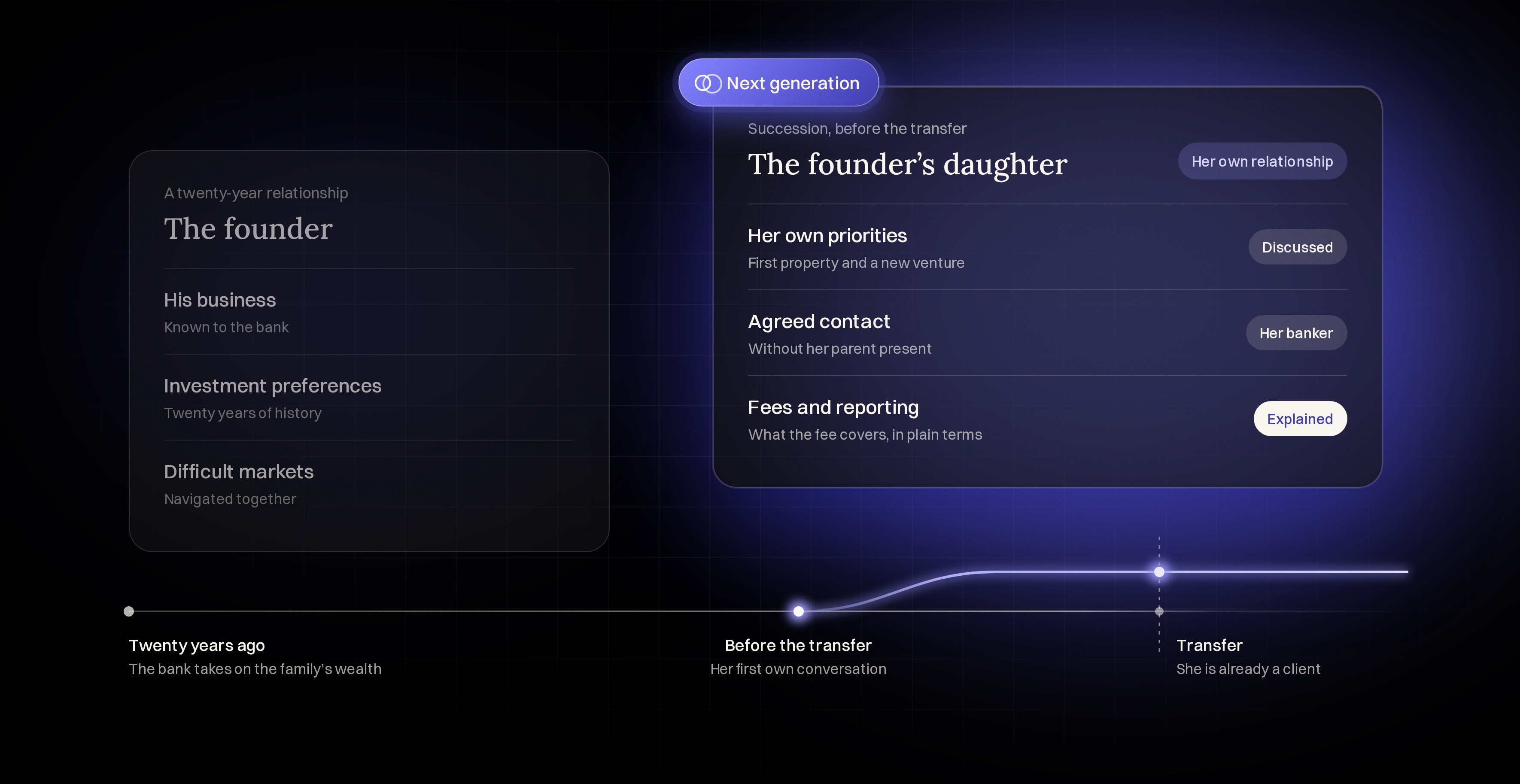


A bank has looked after a family’s wealth for twenty years. The relationship manager knows the founder’s business, understands the investment preferences, and has helped through several difficult markets. The founder’s daughter knows the bank mainly as a name on statements.
When she takes responsibility for the assets, those twenty years will matter less if the bank has never helped her make a decision of her own. The bank may have a longstanding family relationship and still be starting from scratch with its next client.
For banks, retaining wealth across generations means earning the successor’s confidence before the transfer. That requires a relationship of their own, room to make different choices, and a service whose value is clear without relying on the parent’s endorsement.
The Risk Is Visible Before Assets Move
Capgemini’s World Wealth Report 2025 found that 81% of inheritors surveyed planned to switch wealth management firms within one to two years of inheritance. This is stated intent in global research, not an observed switching rate for European banks. It is nevertheless a reason to examine how much of a family relationship depends on one person.
A succession plan can document where assets will go without establishing why the new owner would leave them with the same institution. Banks need to address both. The legal transfer and the decision about who should provide advice are separate events.
Build a Relationship That Belongs to the Successor
An introduction at a family meeting is useful. It does not tell the bank whether a successor is comfortable asking questions, understands the service, or would contact the relationship manager without their parent present.
With the family’s agreement, a bank can offer a successor a conversation about their own circumstances. The agenda might concern a first property purchase, a business venture, or the responsibilities they expect to take on. Starting with something relevant is more useful than asking them to sit through a presentation about the family portfolio.
Financial education can support that conversation, particularly when it addresses a real decision. Explaining a capital call, a lending arrangement, or the fees on a mandate gives someone a reason to return with the next question. Attendance at an event, by itself, offers little evidence that confidence has grown.
The bank also needs to respect what the current client wishes to share. A family relationship does not automatically make every account, document, or discussion available to every family member. Clear boundaries can make it easier for both generations to speak openly.
Allow the New Owner to Make Different Choices
Banks can mistake disagreement with a family’s existing arrangements for a lack of investment knowledge. A successor may understand those arrangements perfectly well and still prefer a different approach.
They may want to start a company, hold more readily available cash, invest through several providers, or delegate less of the decision-making. The discussion should establish the reason for the preference before presenting an alternative.
BCG’s 2026 research on succession describes the growing complexity of ownership and control as family assets and family members become more dispersed. Its analysis, with a particular focus on Asia, helps frame an important question for banks elsewhere: which responsibilities are passing to which people?
The person inheriting shares in a family company may need different support from a sibling inheriting liquid investments. Treating them as a single family profile can obscure those differences. Each prospective client needs a discussion about objectives and the role they want the bank to play.
Keeping part of a relationship on clear terms may be more sustainable than trying to preserve every existing arrangement. A bank should be able to explain its value even when the successor chooses another provider for part of the portfolio.
Look Beyond the Children
The phrase “next generation” can narrow the conversation too quickly. Responsibility may pass first to a spouse, or be shared between several people over time.
The UBS Global Wealth Report 2025 highlights that wealth often transfers between spouses before moving to the following generation. This makes the involvement of a partner who has previously taken a less active role a material part of succession planning.
A bank should understand who makes decisions now, who holds relevant authority, and who may need support later. Those roles can differ. Asking only who will inherit misses the person who may soon have to manage the family’s finances.
Consider a partner taking sole responsibility after a bereavement. They may need a clear explanation of accounts and immediate obligations before a discussion about a long-term investment strategy. The relationship should allow the bank to respond to that situation without forcing someone to establish trust during a crisis.
Make the Value of the Service Easy to Explain
A successor evaluating the bank may ask questions that the existing client stopped asking years ago. What does the fee cover? Which decisions does the bank make? How do I reach the right person? Can I understand the reporting without an advisor talking me through every page?
These are reasonable tests of a service. A clear explanation of responsibilities and costs is more persuasive than a broad assurance that the bank understands wealthy families.
Digital access matters here because it shapes everyday experience. A client who can retrieve a document, see an understandable portfolio view, and follow the progress of a request has less friction in the relationship. Personal advice still needs someone who can respond when the issue requires judgment.
The bank should connect the two. A convenient interface loses value if the client must repeat the same information to several teams. Equally, a capable relationship manager is difficult to appreciate if routine requests take weeks.
Measure Readiness Before Measuring Retention
Assets retained after a transfer are an important outcome, but they arrive too late to guide early engagement. Banks need some indication of whether the next relationship is developing.
Useful measures include whether relevant family members have an agreed contact at the bank, whether their own priorities have been discussed, and whether outstanding succession questions have an owner. Record substantive engagement rather than counting invitations or mailing-list subscriptions as relationship progress.
After a transfer, distinguish changes in asset values from money moved to another institution. Ask why clients retained, reduced, or ended their relationship. That provides more useful information than assuming every departure reflects the same generational preference.
We believe banks are more likely to retain the next generation’s wealth when they treat successors as future clients with their own decisions to make. The existing relationship opens a door. The bank still has to give the person walking through it a reason to stay.
For the founder’s daughter, that reason could be a banker who understood her plans before the inheritance, explained her options without judgment, and followed through when she asked for help. Those are experiences she can rely on herself.
More industry perspectives: Performativ Pulse