

A bank adds a private-market fund to its investment offering. The launch has a clear commercial appeal: clients gain access to a strategy previously beyond their reach, and advisors have something new to discuss. Six months later, a client wants their money back sooner than expected. That conversation will test the offering more thoroughly than the launch did.
Broader access to private markets brings banks a distribution opportunity and a continuing service responsibility. Selection, liquidity explanations, portfolio reporting, and the handling of requests all need to work after the subscription is complete. The quality of that ongoing service will determine whether access builds confidence or creates disappointment.
Access Is Expanding Across Europe
The European Commission describes ELTIF 2.0, applicable since January 2024, as a framework that broadens access to long-term investment funds. It also allows semi-liquid structures to offer redemptions under specified conditions. ELTIFs are one route into private markets, rather than a label covering every private investment.
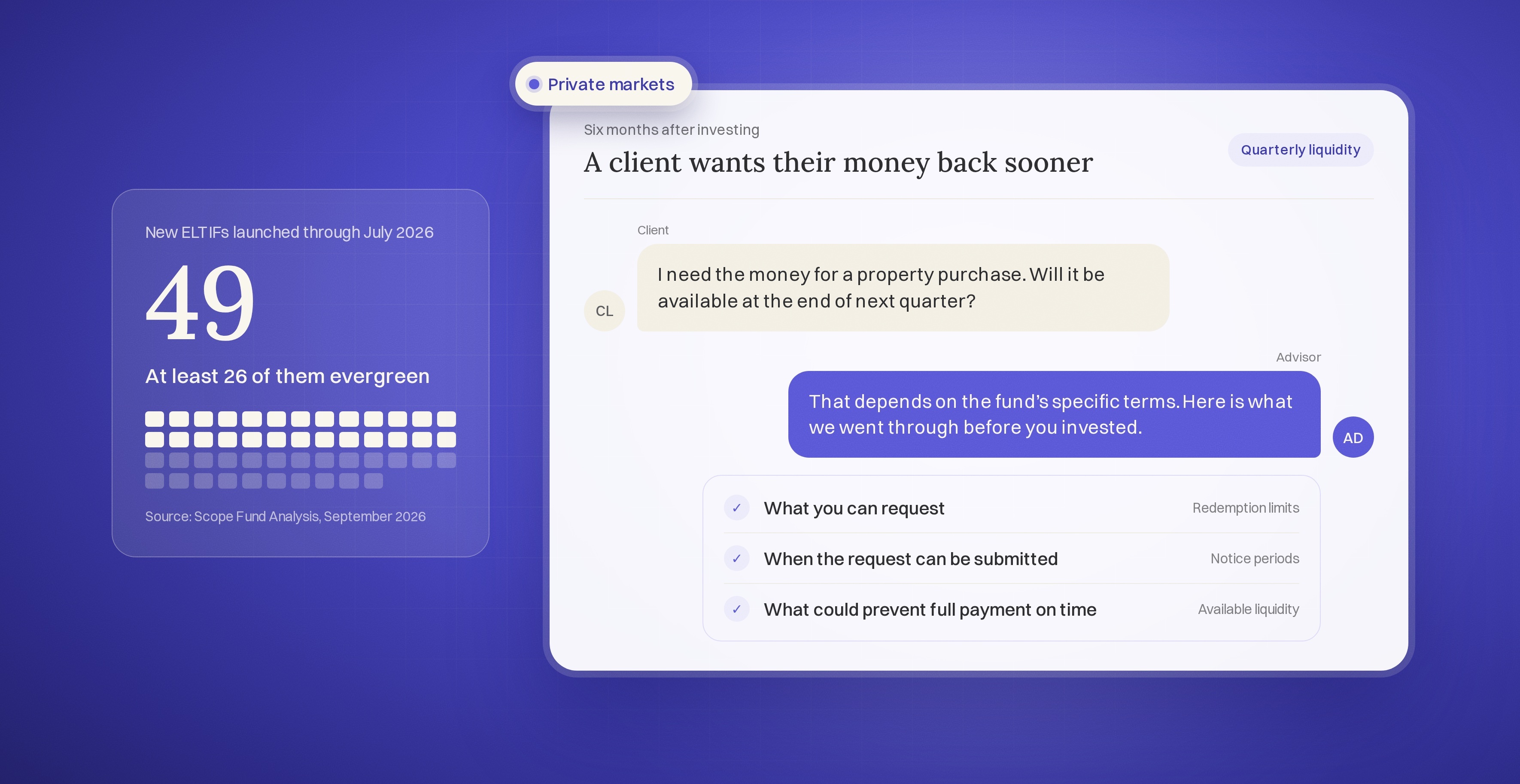
The product mix is changing. Scope Fund Analysis’s September 2026 market review identified 49 new ELTIFs launched through July 2026, at least 26 of them evergreen. It lacked structure data for nine of the launches. This indicates a shift in supply, not proof that every fund is attracting significant demand.
Evergreen generally describes a fund without a fixed end date that can accept ongoing or periodic subscriptions. It does not, by itself, promise unrestricted withdrawals. That difference is fundamental to how a bank explains the product.
The Investor’s Understanding Needs to Match the Terms
A client accustomed to listed funds may hear “quarterly liquidity” and assume that money will be available at the end of the next quarter. The actual outcome depends on the specific fund’s notice periods, redemption limits, available liquidity, and other conditions.
An advisor needs to explain what the client can request, when the request can be submitted, and what could prevent full payment on the expected date. These points should be discussed in ordinary language before the client relies on the investment to meet a future obligation.
The bank can test understanding with a practical situation. If the client wanted to fund a property purchase on a fixed date, would the fund’s terms fit that need? The answer depends on the client and the product. A longer conversation before investing can prevent a much harder one later.
This is also where the broader portfolio matters. Existing commitments, borrowing, planned spending, and other illiquid assets affect how useful an additional private investment would be. A client’s wealth does not make those considerations disappear.
Product Approval Should Include the Service After the Sale
Investment selection and due diligence are essential. The approval process should also establish what the bank can reliably deliver to the client throughout the holding period.
How will valuations reach the reporting team? What happens when a statement arrives late or a fund changes a dealing date? Who explains a partial redemption? Which team checks that a request was submitted correctly and follows up if it was not?
A bank may depend on an asset manager, administrator, custodian, and distribution partner for different parts of that process. The client is unlikely to regard those boundaries as a reason for receiving conflicting answers. Responsibilities and escalation paths need to be agreed before volumes increase.
Commercial approval should therefore include an estimate of the work required to support the product. Subscription volume can look attractive while queries, manual updates, and repeated document checks make each relationship more expensive to serve.
A Portfolio View Must Show What the Numbers Mean
A consolidated report can place a listed holding and a private fund next to each other. That presentation should not imply that both values were established in the same way or at the same time.
A private holding may be reported using a periodic valuation. Depending on the structure, investors may also have undrawn commitments or pending subscriptions that need to be shown separately from invested value. Adding unlike figures together can leave a client with a misleading impression of exposure or available cash.
Banks should preserve valuation dates and make the distinction between reported value and liquidity understandable. Clients need to know what information is current, what remains outstanding, and which amounts represent future obligations.
In their September 2026 risk update, the European Supervisory Authorities highlighted private-credit vulnerabilities including limited transparency, valuation uncertainty, and liquidity mismatches. Those findings concern private credit specifically; they should not be treated as evidence that every private-market strategy carries identical risks.
For a bank distributing such products, these concerns make clear explanations and reliable records especially important. An orderly-looking dashboard cannot remove uncertainty in the underlying investment.
Prepare for the Difficult Conversation
The most useful service test is a situation in which a client cannot get the outcome they expected. Consider a hypothetical redemption request that is only partly met under the fund’s rules.
The bank needs to confirm the status promptly, explain the relevant terms, and distinguish information from the fund manager from its own assessment. The advisor should be able to discuss how the delay affects the client’s wider plans without guessing when the remaining money will arrive.
This is partly a training issue and partly an information issue. An advisor with strong product knowledge still needs access to the current notice and the client’s request history. A service team needs a consistent answer that does not change depending on whom the client calls.
Preparing that response before a problem arises is a practical way to protect the relationship. It also helps the bank recognize whether the service model is ready for a broader investor base.
Distribution Success Extends Beyond Subscriptions
Banks should look beyond the assets raised when evaluating a private-markets offering. The business case needs to include ongoing servicing costs and the quality of the experience during the holding period.
Useful measures include requests completed on time, unresolved reporting issues, repeated manual corrections, and complaints arising from misunderstood terms. Review whether advisors can explain the product consistently and whether clients understand the limits that matter to their circumstances.
A bank does not need the largest shelf of private-market funds to establish a credible offering. A narrower range that fits the intended clients and can be serviced well may be a better starting point than rapid expansion into products the organization struggles to support.
We believe broader access will reward banks that combine informed selection with dependable service. Clients need an institution that can help them understand the investment and remain useful when circumstances change.
For the client requesting an early withdrawal, the defining moment is the answer they receive. It should be timely, accurate, and consistent with what they were told before investing. That is the pace banks need to keep.
More industry perspectives: Performativ Pulse